Posted on
4/5 - (1 vote)

Pass MuleSoft MCPA-Level-1-Maintenance Exam Info and Free Practice Test

New 2023 Latest Questions MCPA-Level-1-Maintenance Dumps – Use Updated MuleSoft Exam

NEW QUESTION 37
Refer to the exhibit.

What is the best way to decompose one end-to-end business process into a collaboration of Experience, Process, and System APIs?
A) Handle customizations for the end-user application at the Process API level rather than the Experience API level

B) Allow System APIs to return data that is NOT currently required by the identified Process or Experience APIs

C) Always use a tiered approach by creating exactly one API for each of the 3 layers (Experience, Process and System APIs)

D) Use a Process API to orchestrate calls to multiple System APIs, but NOT to other Process APIs


NEW QUESTION 38
An Anypoint Platform organization has been configured with an external identity provider (IdP) for identity management and client management. What credentials or token must be provided to Anypoint CLI to execute commands against the Anypoint Platform APIs?


NEW QUESTION 39
What best describes the Fully Qualified Domain Names (FQDNs), also known as DNS entries, created when a Mule application is deployed to the CloudHub Shared Worker Cloud?


NEW QUESTION 40
A company wants to move its Mule API implementations into production as quickly as possible. To protect access to all Mule application data and metadata, the company requires that all Mule applications be deployed to the company’s customer-hosted infrastructure within the corporate firewall. What combination of runtime plane and control plane options meets these project lifecycle goals?


NEW QUESTION 41
When using CloudHub with the Shared Load Balancer, what is managed EXCLUSIVELY by the API implementation (the Mule application) and NOT by Anypoint Platform?


NEW QUESTION 42
A retail company with thousands of stores has an API to receive data about purchases and insert it into a single database. Each individual store sends a batch of purchase data to the API about every 30 minutes. The API implementation uses a database bulk insert command to submit all the purchase data to a database using a custom JDBC driver provided by a data analytics solution provider. The API implementation is deployed to a single CloudHub worker. The JDBC driver processes the data into a set of several temporary disk files on the CloudHub worker, and then the data is sent to an analytics engine using a proprietary protocol. This process usually takes less than a few minutes. Sometimes a request fails. In this case, the logs show a message from the JDBC driver indicating an out-of-file-space message. When the request is resubmitted, it is successful.
What is the best way to try to resolve this throughput issue?


NEW QUESTION 43
A set of tests must be performed prior to deploying API implementations to a staging environment. Due to data security and access restrictions, untested APIs cannot be granted access to the backend systems, so instead mocked data must be used for these tests. The amount of available mocked data and its contents is sufficient to entirely test the API implementations with no active connections to the backend systems. What type of tests should be used to incorporate this mocked data?


NEW QUESTION 44
What is true about API implementations when dealing with legal regulations that require all data processing to be performed within a certain jurisdiction (such as in the USA or the EU)?


NEW QUESTION 45
An organization wants to make sure only known partners can invoke the organization’s APIs. To achieve this security goal, the organization wants to enforce a Client ID Enforcement policy in API Manager so that only registered partner applications can invoke the organization’s APIs. In what type of API implementation does MuleSoft recommend adding an API proxy to enforce the Client ID Enforcement policy, rather than embedding the policy directly in the application’s JVM?


NEW QUESTION 46
Refer to the exhibit. An organization is running a Mule standalone runtime and has configured Active Directory as the Anypoint Platform external Identity Provider. The organization does not have budget for other system components.

What policy should be applied to all instances of APIs in the organization to most effecuvelyKestrict access to a specific group of internal users?


NEW QUESTION 47
What API policy would be LEAST LIKELY used when designing an Experience API that is intended to work with a consumer mobile phone or tablet application?


NEW QUESTION 48
Once an API Implementation is ready and the API is registered on API Manager, who should request the access to the API on Anypoint Exchange?


NEW QUESTION 49
Select the correct Owner-Layer combinations from below options


NEW QUESTION 50
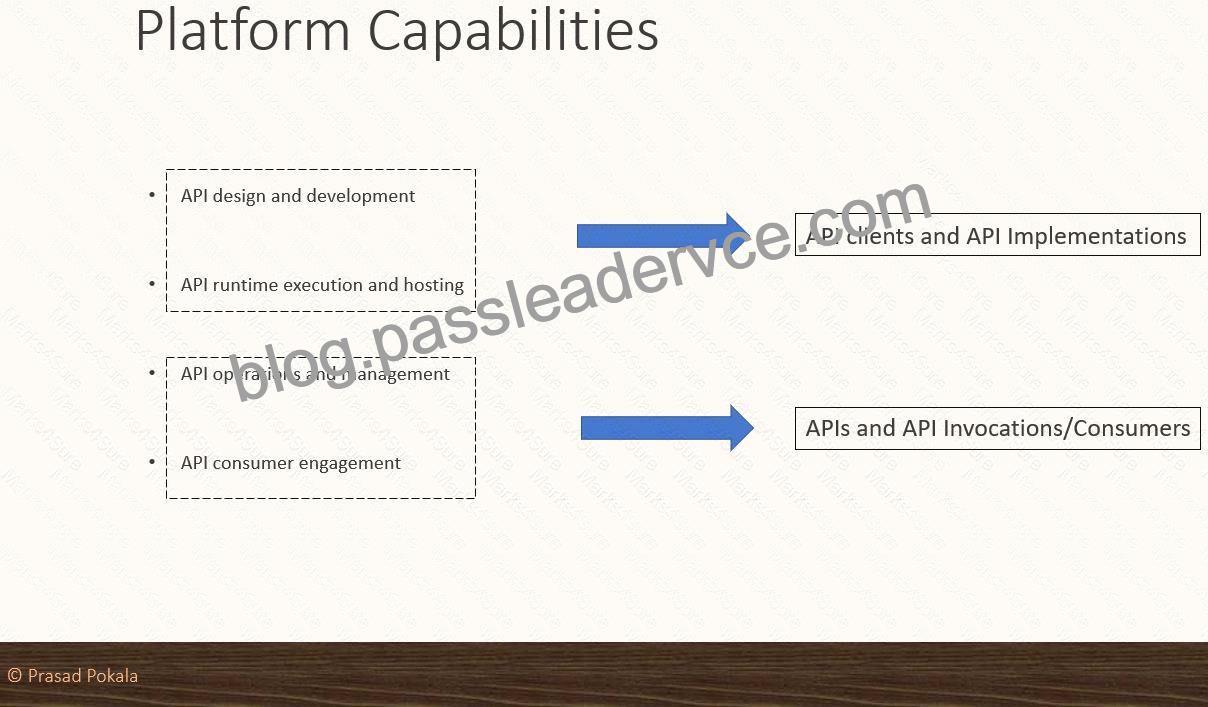
What Anypoint Platform Capabilities listed below fall under APIs and API Invocations/Consumers category?
Select TWO.


NEW QUESTION 51
Which layer in the API-led connectivity focuses on unlocking key systems, legacy systems, data sources etc and exposes the functionality?


NEW QUESTION 52
Refer to the exhibit.

Three business processes need to be implemented, and the implementations need to communicate with several different SaaS applications.
These processes are owned by separate (siloed) LOBs and are mainly independent of each other, but do share a few business entities. Each LOB has one development team and their own budget In this organizational context, what is the most effective approach to choose the API data models for the APIs that will implement these business processes with minimal redundancy of the data models?
A) Build several Bounded Context Data Models that align with coherent parts of the business processes and the definitions of associated business entities

B) Build distinct data models for each API to follow established micro-services and Agile API-centric practices

C) Build all API data models using XML schema to drive consistency and reuse across the organization

D) Build one centralized Canonical Data Model (Enterprise Data Model) that unifies all the data types from all three business processes, ensuring the data model is consistent and non-redundant


NEW QUESTION 53
What Mule application deployment scenario requires using Anypoint Platform Private Cloud Edition or Anypoint Platform for Pivotal Cloud Foundry?


Latest MCPA-Level-1-Maintenance Exam Dumps MuleSoft Exam: https://www.passleadervce.com/MuleSoft-Certified-Platform-Architect/reliable-MCPA-Level-1-Maintenance-exam-learning-guide.html


Related Links: myportal.utt.edu.tt myportal.utt.edu.tt myportal.utt.edu.tt myportal.utt.edu.tt myportal.utt.edu.tt myportal.utt.edu.tt

Leave a Reply

Your email address will not be published. Required fields are marked *

Enter the text from the image below